
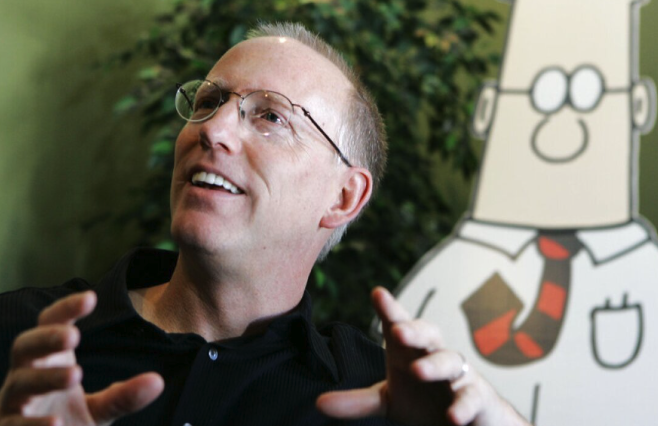
Scott Adams, the creator of the long-running comic strip Dilbert, passed away this week after a battle with cancer. But instead of a respectful send-off, several major media outlets wasted no time in throwing dirt on his name, seizing the moment to push narratives that overshadow the legacy of a man who entertained millions.
The New York Times led the charge with a breaking news alert that couldn’t resist a final jab, reminding readers that Adams had “made racist comments on his podcast.” That framing didn’t stop there.
The Times obituary painted Adams as someone “furious” about the consequences he faced after supporting Donald Trump — as if expressing political opinions outside the liberal mainstream is an offense worth remembering above all else.
Then came People magazine, calling back to 2023 when Dilbert was pulled from wide circulation. Their headline? A focus on Adams’ “racist rant.” It was a move echoing the same old formula: grab the controversy, bury the context, and reduce a decades-long career to one hot-button moment.
The Washington Post joined in with their own label, referring to Adams as a “far-right” political commentator — a term that gets thrown around so casually it’s lost any real meaning.
In truth, Adams’ views were largely aligned with mainstream conservative thinking. He was provocative, sure, and he didn’t back down from saying what he thought — especially about politics, media narratives, and culture. But “far-right”? That’s not just a stretch. It’s a distortion.
What these outlets downplayed — or ignored entirely — was the huge fanbase Adams built over the years. Dilbert was more than a comic strip. It was a cultural staple, especially in the workplace, skewering corporate absurdity with dry wit and sharp insight.
His readers followed him long after the comic pages, tuning into his live streams, reading his books, and engaging with his ideas, whether they agreed or not.
In his final hours, Adams reportedly converted to Christianity. The White House even issued a tribute, acknowledging his impact. But for too many in the media, those details were footnotes at best.
Scott Adams was a complex figure — like most people are. But to reduce him to a single controversy, especially in death, says more about the media’s priorities than it does about the man himself.