
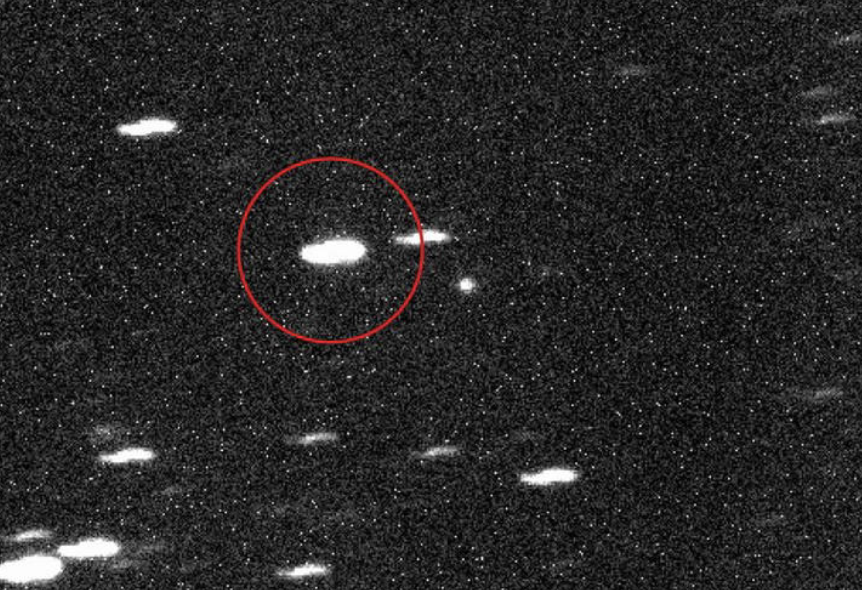
So here’s the setup: NASA spots a brand-new interstellar object, 3I/ATLAS, cruising through the solar system. That’s “interstellar” as in: “this thing didn’t come from around here.” It’s only the third object of its kind ever detected. And right out of the gate, scientists were saying, “It’s probably a comet.” Case closed, right?
Enter Harvard astrophysicist Avi Loeb, a man who’s not afraid to throw a wrench into the scientific status quo. You might remember him from the ‘Oumuamua debates back in 2017 — another mystery visitor from beyond the stars. Now he’s back, and this time he’s bringing receipts “and” a custom scoring system.
Yep, Loeb just introduced something called the “Loeb Scale”, a 1-to-10 system for rating whether something floating through space might actually be… alien technology. And he’s giving 3I/ATLAS a “six out of ten”. That’s not “definitely a UFO,” but it’s also “not” “just a rock,” either.
Now, here’s where it gets really juicy.
Loeb’s pointing out some weird behavior. First off: “no tail”. Comets usually have one — a long, glowing streamer of dust and gas. But 3I/ATLAS? Nada. Also, it’s traveling on a “retrograde orbit” — moving opposite the direction most planets orbit. That’s like a car driving the wrong way down a highway, except it’s doing it at “60 miles per second”. Oh, and its path just happens to align “suspiciously well” with Earth’s.
Coincidence? Loeb doesn’t think so.
He’s floated a theory that reads like something out of a movie: 3I/ATLAS might actually be a “mothership”, deploying tiny probes to Earth using something called a “reverse Oberth maneuver” — a clever way to use the sun’s gravity to slow down and sneak in quietly. Those mini-probes? They might show up between November 21 and December 5, 2025.
Let me say that again: a Harvard physicist just gave us a possible “alien arrival window”.
Now, obviously, not everyone is on board. Oxford astronomer Chris Lintott called the whole idea “nonsense on stilts” — which, let’s be honest, is kind of an incredible insult. But Loeb isn’t backing down. He’s published multiple papers, pointed to the object’s unusual lack of gas emissions, and even proposed using NASA’s “Juno spacecraft” to intercept the object near Jupiter in 2026. He’s pushing for a global task force — not just scientists, but also policymakers and psychologists — to figure out how we’d “even begin” to respond to something like this.
And look, even Loeb admits that if it “is” a spacecraft, we probably can’t catch it. It’s just too fast. At best, we can study it. At worst, well… he dropped a “Pascal’s Wager” on us: better to prepare for an alien encounter and be wrong than ignore it and regret it.
Bottom line? Whether you’re a hardcore skeptic or you’ve got your eyes on the sky and a copy of “Independence Day” queued up, one thing’s for sure: “3I/ATLAS is not your average space rock.” And according to one of the boldest minds in astrophysics, we might want to keep watching.
Because something’s already in our backyard. And it’s moving fast.